Tag: Machine learning

  • NaviGateAI

    Project overview

    NaviGateAI develops and field-validates an interoperable real-time decision support platform that strengthens situational awareness in emergency response. The project delivers a TRL 7 MVP that fuses drone video, wearable and helmet sensors, thermal and visual streams, IMU, and a priori building and geospatial data into a continuously updated 3D operational picture with prioritized, explainable recommendations for incident command, supporting fast “how”, “why”, and “what-if” queries.

  • From Architecture to Machine Learning: Xinyue Wang on Making Early-Stage Energy Optimisation Practical

    From Architecture to Machine Learning: Xinyue Wang on Making Early-Stage Energy Optimisation Practical

    What if predicting building energy demand did not require long simulation runs, heavy workflows, or massive datasets?

    Xinyue Wang recently defended her PhD, “Leveraging Machine Learning to Improve Early-stage Building Energy Optimization.”

    Originally trained as an architect, her research sits at the intersection of building energy simulation and machine learning. Her work focuses on making data-driven methods usable in early design stages, prioritising simplicity, interpretability, and practical relevance over complexity.

    Below, Xinyue reflects on her research, her design perspective, and what she hopes others will take from her work.

    You began in architecture and now work at the intersection of building energy simulation and machine learning. How do you usually describe what you do to people?

    I normally say, ‘I used machine learning to predict the energy demand based on how the building looks, so I can help architects to design more energy-efficient buildings.’

    Do you feel like your architectural training shaped the kinds of research questions you care about, compared to someone who might come from a purely technical background?

    Definitely yes! As an architect (or architecture student), I understand that architectural problems cannot be approached from a single technical metric alone, like energy consumption. I also recognize that architects cannot simply give up considerations of design intent and aesthetics. Therefore, I am more inclined to approach energy reduction from an architect’s perspective, by designing tools that architects can actually use—tools that help reduce building energy consumption without compromising much design quality.

    A central contribution of your work is identifying which architectural design variables actually matter. Why is this step more important than simply building more powerful prediction models?

    Identifying which architectural design variables actually matter is the very first step in building my machine learning models, and it forms the foundation of all subsequent research. Moreover, this step involves the most interaction with stakeholders throughout my entire research process, which is why I devoted a significant amount of time and effort to it.

    You deliberately chose to work with simpler, more interpretable machine learning models. What does that choice say about your philosophy toward tools in design and research?

    From the outset of defining my research scope, I made a conscious decision to prioritize model simplicity and interpretability over maximizing predictive accuracy. This preference reflects the practical constraints of architectural research, as lighter-weight models can be developed with smaller datasets and require significantly less computational and training time. Moreover, my research focuses on the early stages of architectural design, where time efficiency is more critical than marginal gains in accuracy. Therefore, simpler and more interpretable machine learning models are more appropriate for this context.

    More broadly, in machine learning research, I do not believe it is always necessary to pursue increasingly complex or sophisticated models. If a simpler model is sufficient to accomplish the task, there is nothing inherently inferior about that choice.

    What did you learn about the relationship between model accuracy and usefulness in practice through your experiments?

    My research results show that in early-stage architectural applications, accuracy does not need to be overly emphasized. Part of the reasons is that there is inherently a high level of uncertainty in the early phases of architectural design, and at this stage, time efficiency is far more important than accuracy.

    Your work with synthetic datasets highlights both opportunities and limitations. What should researchers and designers be most careful about when using synthetic data to inform decisions?

    I believe the most important thing is to clearly understand the limitations of synthetic datasets when applying them, and to combine the results derived from synthetic data with real-world conditions in practice.

    Given the context of your work, how do you see the relationship between machine-generated outputs and an architect’s judgement evolving?

    I believe the two will never be fully aligned. In the context of architectural design, subjective aesthetic judgment by the architect will always play a dominant role. Machine-generated outputs are more likely to function as intermediate results or benchmarks, providing guidance rather than replacing the architect’s decision-making.

    How do you hope your research might influence the way data science is taught to architecture and engineering students?

    I hope it can help students realize that data-driven approaches are not something overly grand, highly technological, or difficult to achieve. It is not necessary to rely on extremely complex algorithms or massive datasets to build meaningful models and apply them within the field of architecture.

    What kinds of questions, projects, or collaborations are you most curious to explore next?

    There are many! To give a few examples, I am interested in exploring how different models can be combined with optimization algorithms to examine what level of accuracy is sufficient in practice. I would also like to apply my research to renovation projects or urban planning contexts. Additionally, I am curious about shifting the objective from energy performance to other goals, such as life cycle assessment (LCA) or daylighting analysis.

    Outside of research, what do you enjoy spending time on when you are not thinking about energy models and machine learning?

    Climbing. But mainly just yap with my friends in the climbing gym instead of actually climbing.

    Finally, if someone reads your thesis but only takes away one idea, what do you hope that idea is?

    That meaningful models for early-stage applications can be built using a relatively small amount of data and simple machine learning algorithms.

    If you are interested in collaboration, applications in renovation or urban contexts, or data-driven methods in architectural design, feel free to reach out.

    Once again, congratulations to Dr. Xinyue Wang on this important milestone.

  • Predicting the Wind – Janne’s Journey from ETH to Chalmers

    Predicting the Wind – Janne’s Journey from ETH to Chalmers

    This week, we talk with Janne, a visiting masters student at the Sustainable Built Environments research area at Chalmers University. Janne is currently completing his MSc in Integrated Building Systems at ETH Zürich and joined the team through an IDEA League research exchange. His project applies machine learning to predict urban wind patterns, and we sat down to learn more about the challenges and potential of this exciting work.

    Hej Janne! Could you tell us a bit about your background—how did your path lead from ETH Zurich to Gothenburg (and SBE!), and what sparked your interest in using machine learning for CFD simulations?

    I hold a BSc in Architecture and am currently completing my MSc in Integrated Building Systems at ETH Zürich. My interest in scientific machine learning began with a previous project focused on urban comfort analysis, particularly heat island effect prediction. Through my ETH supervisor, Prof. Guillaume Habert, I was introduced to Prof. Alexander Hollberg at Chalmers, which led to my current research exchange position funded by the IDEA League.

    Can you walk us through the core idea of your project? What are you trying to improve or find out by applying machine learning to urban-scale CFD?

    The core of my project is to develop a surrogate model that predicts urban wind speeds using an image-based machine learning workflow. Current research in this area focuses on small-scale case studies, but I am exploring whether a model trained on CFD data from the entire city of Gothenburg can still deliver accurate results. The goal is to test the scalability and real-world applicability of these methods at the urban scale.

    What kinds of questions or problems do you think your approach could help answer in the future?

    The machine learning approach could replace costly, outsourced wind‑simulation studies with an instant neural‑network surrogate, putting real‑time wind feedback directly in architecture office’s design tools. Early-stage design iterations could incorporate wind comfort considerations right from the start.

    Have you encountered any unexpected challenges or interesting patterns while working with the simulation data? How did you deal with them?

    A major challenge was managing watertight high resolution building and terrain geometries and generating CFD data across an entire city. Fortunately, I’ve had great support from Dr. Franziska Hunger at the Fraunhofer-Chalmers Center, who produced and provided me with a robust validation dataset.

    What has it been like working with the Sustainable Built Environments research area during your visit—any moments, discussions, or perspectives that stuck with you?

    At the Sustainable Built Environment research area, I found an amazing group of people, where every opinion is valued and I felt immediately heard, even as a guest master student. Their genuine interest in my project, eagerness to connect me with the right experts, and the dedicated life/research check-ins made me feel very welcomed.

    You’ll be heading back home soon – what’s the first thing you’re looking forward to doing once you’re back?

    I am very much looking forward to getting back on my bike, I’ve got some epic bike tours planned for the summer and can’t wait to go on those long rides!

    A big thank you to Janne for sharing his project and experience with us. We’re excited to see how his work contributes to real-time environmental feedback in urban design and planning.

  • Interview with Xinyue on her research visit at the University of Washington

    Interview with Xinyue on her research visit at the University of Washington

    We recently caught up with Xinyue about her research visit at the University of Washington. During her stay, she explored innovative machine learning methods to enhance building sustainability—not only in terms of energy efficiency but also in indoor air quality and urban energy dynamics. In this interview, Xinyue discusses her motivation for the visit, insights from international collaboration, and plans to integrate new ideas into her ongoing research at Chalmers.

    What motivated you to pursue a research visit at the University of Washington, and how does this experience align with your work at Chalmers?

    Being able to collaborate and network internationally is something I’ve always wanted to do during my PhD. Moreover, during my licentiate, I had many questions regarding my research—specifically, whether the methods are still valid outside of the Swedish context. Therefore, it will be nice to have a chance to figure it out.

    What key insights or discoveries did you gain from collaborating with researchers at the University of Washington?

    I learned more about using machine learning methods to improve building sustainability at different levels—not only for single-building energy, but also for indoor air quality and urban energy.

    How has this experience influenced your approach to your ongoing projects in sustainable built environments?

    I presented my research to the entire research group and received valuable feedback on hyperparameter selection and dataset development for my model. I would like to integrate these suggestions into my research.

    Did you encounter any unexpected challenges during your visit, and how did you manage them?

    Obtaining my visa turned out to be more challenging than I anticipated. The entire process takes around two months, which shortened my research visit.

    What aspect of the University of Washington’s research culture would you like to incorporate into your work at Chalmers?

    They hold an end-of-quarter seminar in which everyone presents their work from throughout the semester, allowing for the exchange of ideas. I think that could be a nice practice to adopt.

  • Xinyue has defended her licentiate thesis

    Xinyue has defended her licentiate thesis

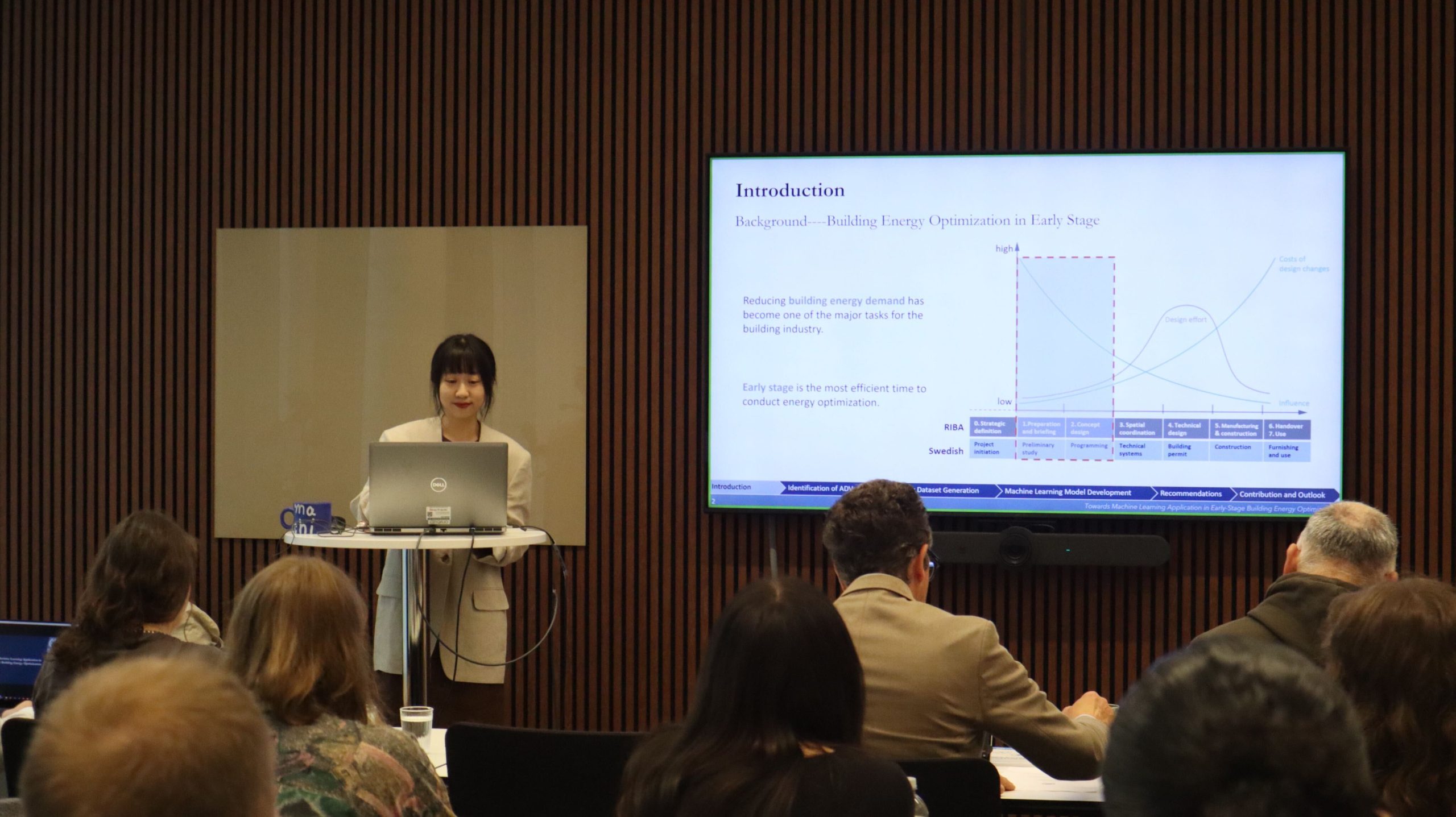
    On June 10th, Xinyue Wang presented at her Licentiate seminar defending her thesis entitled ‘Towards Machine Learning Application in Early-Stage Building Energy Optimization’. Her thesis discusses how to develop a machine learning building energy prediction model to substitute the traditional simulation engines in early stage optimization workflow for higher efficiency. Professor Paul Sheperd, from the University of Bath, was invited as the discussion leader.

    More information about the licentiate thesis can be seen here.